This DAO is archived. Data may be stale and governance actions are disabled. Want to reactivate this DAO? Contact support.
DRS is paused and scores are frozen to preserve previous work and community resources during this period of limited voting while we define our future governance path.
OIP #4 Delegate Compensation and Delegate Reputation Score Integration (stOBOL)

Result details
63 addresses
3.32M votes

695.67K

404.45K

271.55K

187.93K

174.2K

159.93K









Final Votes
Quorum
3.41M of 3.14M
Majority support
Yes
For
3.32M
Against
1.86M
Abstain
89.26K
Actions
No onchain actionsThis proposal asks for a vote with no onchain actions to carry out.
Proposal
Proposal
Status: Final
Proposal Type: Contract upgrade
Abstract
This proposal introduces two upgrades to enhance the governance system for stOBOL:
- Delegate compensation mechanism: A reward system that distributes rewards to active delegates from a dedicated pool, separate from the staking rewards.
- Delegate Reputation Score (DRS) integration: A lightweight activity tracking and reputation layer, enabling transparency and accountability in delegate performance. Staking rewards for token holders and delegates can depend on delegating to an “active delegate” as determined by DRS.
This proposal - originally posted May 14, 2025 - has been updated to reflect community feedback. It lays the foundation for a system that can evolve in the future.
Motivation
The Obol Collective is committed to building a governance system that rewards active contribution over passive token holding. To realize this vision, Tally proposes to align incentives around meaningful participation in governance.
This proposal introduces two key upgrades to Obol’s staking and delegation flow: delegate compensation and Delegate Reputation Score (DRS) integration. Together, these mechanisms ensure that rewards flow toward the individuals and behaviours that sustain and improve the protocol.
- Delegates are rewarded for active participation—such as voting and protocol stewardship—through a separate compensation pool.
- Token holders earn staking rewards by participating directly or by delegating to proven, active delegates as measured by the DRS.
The goal is to introduce an integrated, high-integrity incentive structure that:
- Makes Obol’s governance more robust by rewarding verifiable contributions,
- Encourages long-term commitment by linking rewards to activity,
- Aligns token holder incentives with the protocol’s success,
- Establishes transparent reputationnal signals to help delegates stand out and voters make informed choices.
Whether or not we’re currently seeing participation problems, the core principle remains: no one should have to work for free, especially not long-term. Yes, the TGE moment creates short-term energy. But adrenaline fades, and when it does, clear structures matter.
The long-term vision is to gradually increase the value we place on delegate work over time. This proposal is framed as a first version, designed to pilot the system with 10% of rewards allocated to delegates. That balance may change in future governance cycles.
In the future, we expect delegate rewards to come from the same pool as staking rewards, with a fixed % redirected toward governance participation. For this initial period with an already live staking rewards pool, a separate reward pool helps isolate and test the mechanism.
We also acknowledge feedback that current delegate participation is healthy and that there’s no major problem to solve right now. That’s precisely why it’s a good time to build the right structure, before scaling issues emerge.
Some of the largest DAOs are now dedicating enormous resources to retroactively solve participation challenges. Obol has the opportunity to build that foundation upfront, leveraging lessons from those who came before.
This proposal is modular by design and can be improved in future iterations.
Specifications
Delegate compensation mechanism
We propose implementing a reward mechanism where a dedicated pool of rewards is distributed to active delegates.
- 165,000 OBOL tokens from a separate delegate reward pool (not the staking pool), to be distributed over 6 months (or until when the current reward pool will empty).
- Rewards distributed proportional to the square root of voting power, to reduce the risk of centralization and create a flatter reward curve.
- In future phases, rewards may be weighted directly by DRS.
Linear vs √Power Rewards
Here would be a simplified example of the rewards distribution: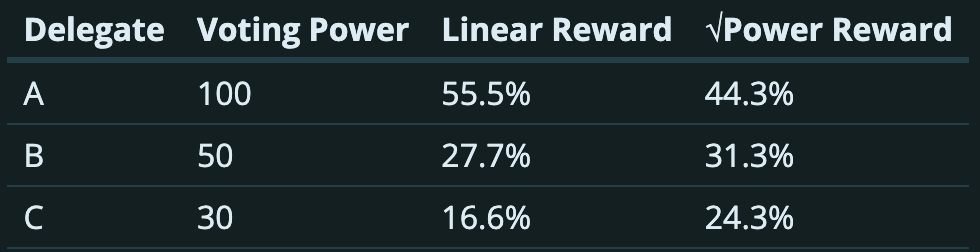 This curve flattens the advantage of large delegates and better rewards smaller but engaged participants.
Goals
- Reward active participation in governance
- Reward token holders for delegating to active delegates. Alternatively, token holders can earn rewards by participating directly.
- Support long-term commitment to Obol governance.
How it works
Obol would upgrade the existing staking system to add new requirements:
- Stakers would only be eligible for rewards if they’re delegated to an “active” delegate
- “Active” would be defined as having a minimum DRS.
- Obol Association will align with DRS Provider on how to calculate a delegate’s DRS. A first (subject to modification) calculation model is outlined below.
- “Active” would be defined as having a minimum DRS.
- 165,000 OBOL tokens (equivalent to 10% of the global staking rewards pool for the first 6 months of staking) from a separate delegate reward pool (independent of staking rewards) would be distributed to active delegates, proportional to their voting power.
DRS Integration
As part of this initiative, the Obol Collective is currently evaluating multiple potential scoring system providers, including but not limited to Karma and Curia. While both offer viable approaches to delegate reputation scoring, their integration timelines, oracle compatibility, and infrastructure readiness may vary. DRS will use a single oracle implementation per cycle. Karma and Curia have confirmed compatibility with Tally and can operate off the same version-controlled logic.
To ensure implementation proceeds smoothly post-approval, this proposal grants the Obol Association, in collaboration with Tally, the authority to select the most technically viable and aligned provider for the first deployment of the Delegate Reputation Score.
This flexibility allows the Collective to:
- Launch the scoring system without delays,
- Maintain compatibility with Tally’s staking and governance UI,
- Optionally rotate or expand to additional providers in future phases, based on performance and community feedback.
- Regardless of the initial provider selected, the DRS calculation logic will remain publicly auditable, version-controlled, and subject to future governance updates
Delegate Reputation Score (DRS)
DRS defines who is eligible to receive rewards and ensures that rewards go to delegates who are consistently participating. It is calculated as a moving average over the past 63 days (equivalent to three voting cycles), designed to reflect recent contributions rather than reputational inertia. Because DRS is based on a rolling 63-day window, scores naturally decay when delegates stop participating, ensuring that rewards reflect current, not historical, legitimacy.
To ensure transparency and fairness, the DRS will be based on a composite of measurable governance activities, with the following simplified structure inspired by existing systems like Curia and Karma:
DRS Formula:
DRS = (Voting Participation Score × 0.40)
+ (Voting Impact Score × 0.10)
+ (Voting Timeliness Score × 0.15)
+ (Rationale Submission Score × 0.15)
+ (Forum Score × 0.20)
Each metric is normalized on a 0–100 scale and contributes to the total Delegate Reputation Score (DRS) according to its weight. These definitions are adapted from Curia’s scoring model and may evolve based on community feedback.
Classification:
- Active: Maintains over 65% DRS over the past 63 days (≈3 governance cycles)
- Inactive: Below 65% DRS
- Ghost: Has voting power delegated but has not voted at all
If necessary, the Association may update the DRS formula during this pilot phase, based on informal community consultation.
In the future, this formula is subject to change and can be updated through an OIP or by a working group appointed by the association through an OIP if judged necessary.
Possible future improvements include:
- Backup Delegations: allowing delegates to nominate fallback delegates while away, subject to DRS constraints.
- Delegator Diversity and Engagement Caps: to further mitigate whale dominance.
Score Components:
- **Voting Participation Score (40% weight)**We merged Number of Votes and Participation Rate into a single Voting Participation Score to avoid over-counting similar behaviors and to streamline the formula. This ensures we reward consistent, eligible participation without overweighting sheer voting volume.
- What it is: A combined metric that captures both how frequently a delegate votes and how engaged they are relative to the number of proposals they were eligible to vote on. It replaces and simplifies the separate “Number of Votes” and “Participation Rate” scores into a single, more intuitive component.
- How it works:
- Each delegate’s voting frequency is calculated as a percentage of all proposals they were eligible to vote on within the rolling 63-day window. This raw participation percentage (e.g., voting on 8 out of 10 proposals yields a score of 80) is used directly as the Voting Participation Score.
- Why it matters: Raw vote counts can over-reward large or early delegates. Participation rate alone doesn’t capture effort in contexts where proposal volume varies. This unified score reflects a delegate’s sustained commitment to governance without overemphasizing raw numbers or diluting quality signals.
- Voting Impact Score (10% weight)
- What it is: Measures how much influence a delegate had in the votes they participated in.
- How it works: For each proposal, it calculates the share of voting power a delegate used compared to the total votes cast. Then it averages that across all proposals and normalizes to 0–100.
- Why it matters: This score distinguishes delegates who cast high-weight, meaningful votes from those with little impact, helping highlight influential decision-makers.
- Voting Timeliness Score (15% weight)
- What it is: Time-decay model that rewards delegates who vote early, reflecting their proactive engagement. This method balances the encouragement of timely participation with fairness to all delegates.
- How it works:
- Votes cast within the first 48 hours receive a score of 100. After 48 hours, the score decays linearly to 0 by the end of the voting period. For example, in a 5-day (120-hour) voting window, the score decreases by approximately 1.39 points per hour after the initial 48 hours. This approach maintains transparency and avoids complexity introduced by additional bonus layers.
- Why it matters: Rewards early and proactive governance participation. Discourages last-minute or opportunistic voting.
- Rationale Submission Score (15% weight)
- What is is: A new scoring component within the Delegate Reputation Score (DRS) that rewards delegates for submitting written rationales on the Forum explaining their votes. This reinforces transparency and supports informed delegation decisions.
- How it works:
- Delegates receive points based on the timeliness of their rationale submissions:
Rationale Submission Timing-bonus options
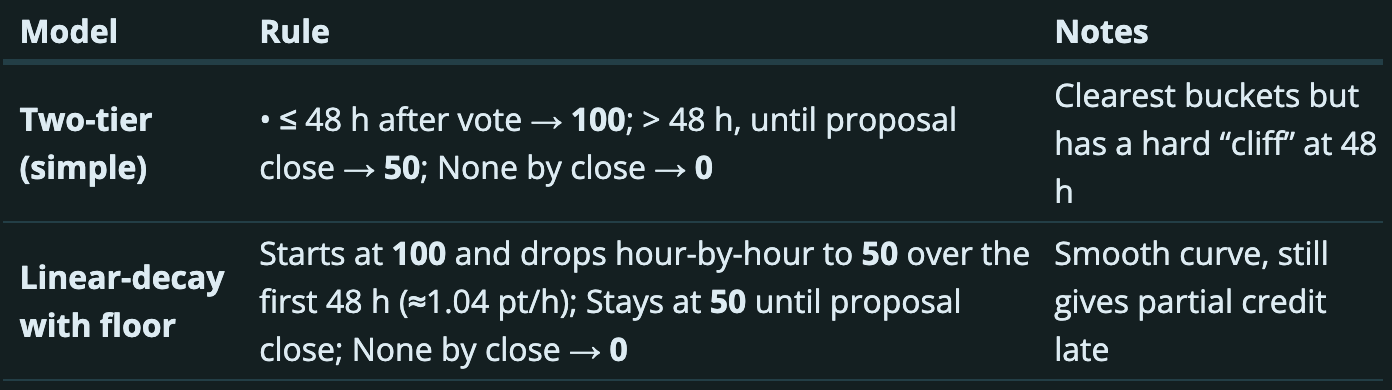
Raw points from either model already sit on a 0–100 scale, ready to plug into the 15 % weight.
Standardizing the rationale format
Delegates shall follow this template when posting voting rationale:
Vote: For / Against / Abstain
Rationale: <concise reasoning here>
- Why it matters: Providing voting rationales is a governance best practice. It helps token holders understand the thinking behind a vote, increases trust, and reinforces a culture of accountability. This scoring mechanism encourages consistency without introducing heavy evaluation processes, with quality assessment to be considered in future iterations.
- Forum Score (20% weight)
- What it is: Measures off-chain engagement in the governance forum (posts, comments, discussions).
- How it works: Derived from multiple signals like number of proposal discussions joined, topics started, likes received, and reading activity. Normalized and simplified for the MVP.
- Why it matters: Delegates who contribute in the forum often shape decisions early and improve proposal quality. This score rewards those who help make governance deliberative, not just performative.
Integration details
- Smart contract changes required to enable Oracle listener.
- DRS Oracle will score and flag “active” delegates based on voting and proposal participation.
- Tally will handle coordination and UI updates to integrate DRS into delegate profiles.
User interface
- Tally will add support for delegate compensation to the UI
- Tokenholders would be able to see delegates’ DRS scores and eligibility statuses when staking
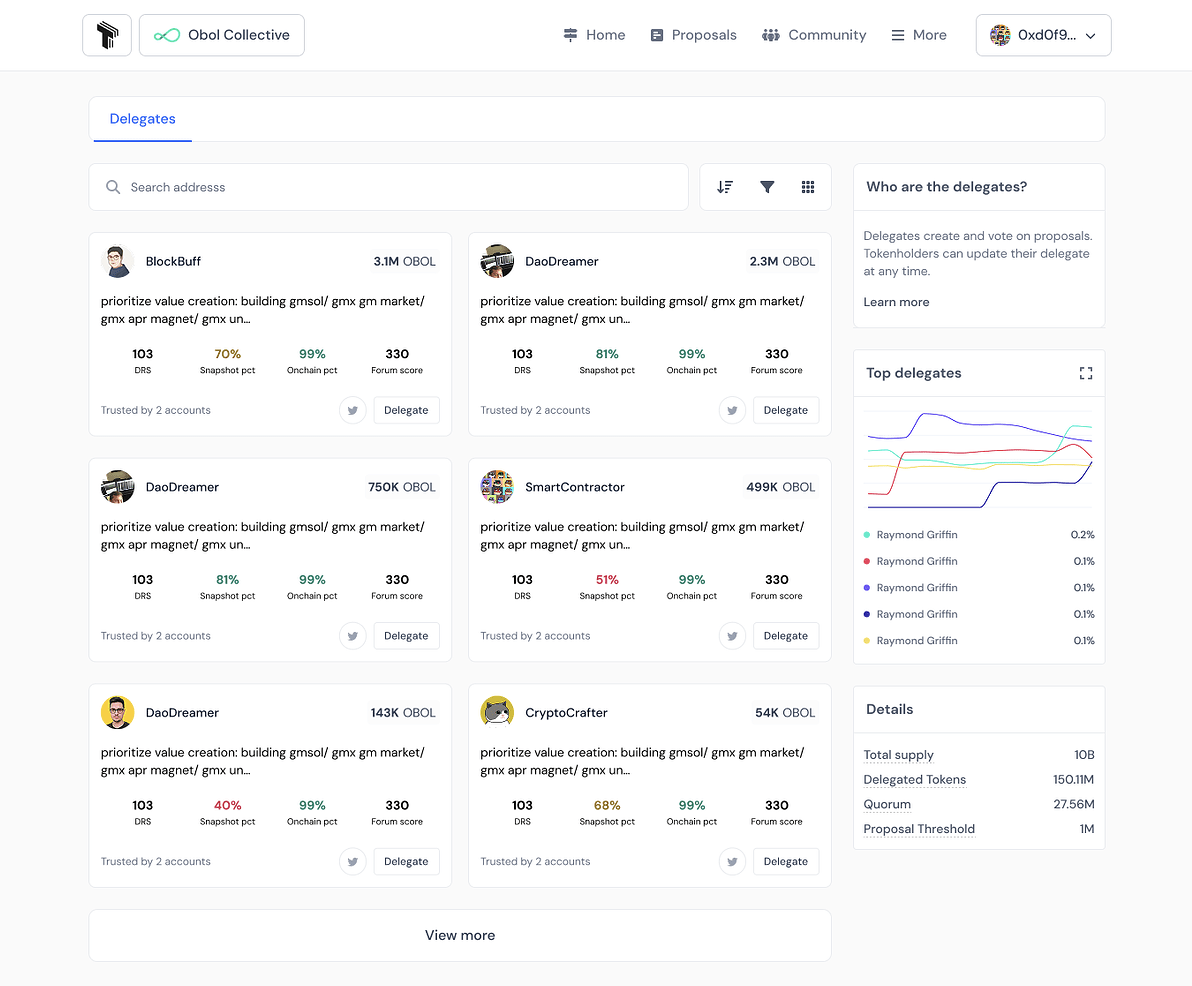
- Tokenholders would be able to see delegates’ DRS scores and eligibility statuses when staking
- Delegates would be able to see and claim their accrued rewards from their profile page
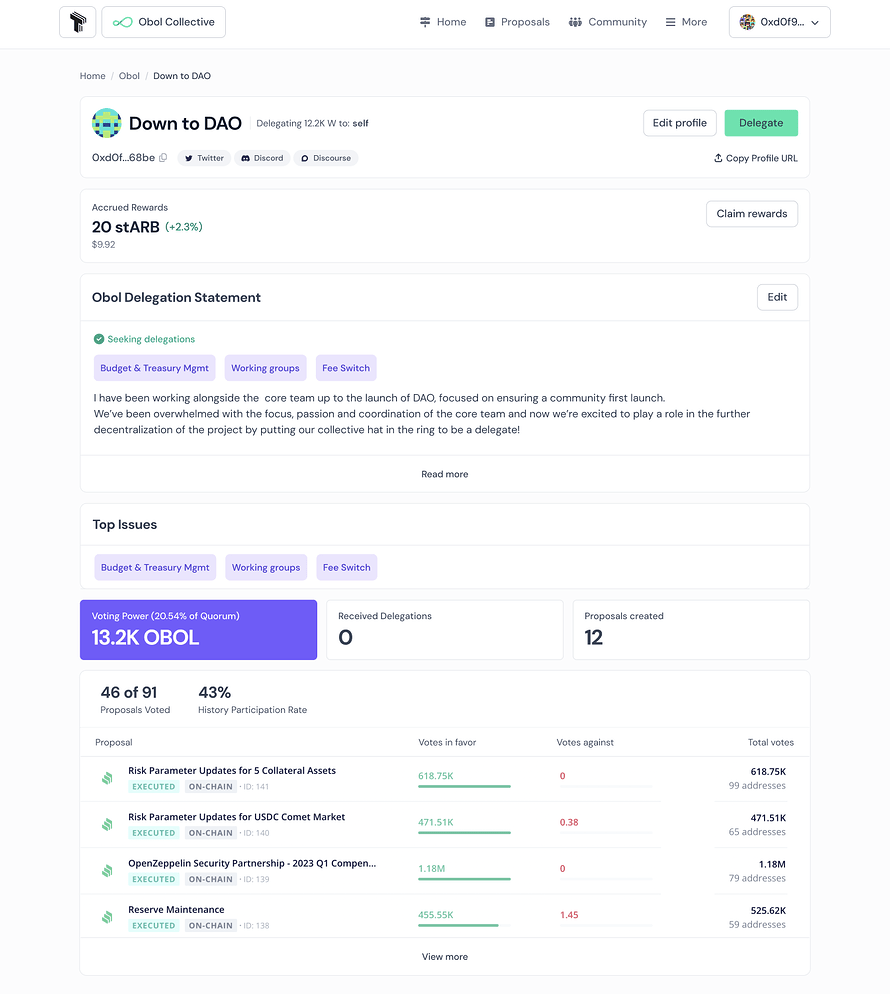
- These features would be live at both vote.obol.org/stake and tally.xyz/gov/obol/stake
- Eligibility requirements:
- Must be deemed “active” by DRS Oracle (details below).
Technical scope
- Implement a new earning power calculator smart contract that sends rewards to active delegates
- Front-end UI components
- Show eligibility and DRS when delegating
- Let delegates see and claim their rewards
- Dependency, not included in scope: Obol to set up DRS Oracle
- Dependency, not included in scope: DRS Oracle to put scores on-chain
Forum Integration of DRS
In addition to incorporating DRS into staking and delegation flows, the Obol Collective is exploring ways to extend DRS visibility into the governance forum. This would allow delegates to link their forum accounts to their on-chain identities and display their DRS alongside posts and comments.
This feature would serve two purposes:
- Help delegates verify their identity across platforms, increasing trust in discussion.
- Allow token holders to better contextualise forum participation with transparent reputation signals.
This integration is currently under technical review. If confirmed, it could be implemented either by Tally or funded through a small standalone grant, similar to the below proposed Telegram alert feature. A future update will provide details if this path is pursued.
UI and Notification Features
- Tally will replace the Top Delegates leaderboard with a DRS-based version, rather than sorting by raw voting power.
- Curia, Karma, and others may build complementary interfaces that enrich DRS displays drawing on both on-chain metrics and forum-based engagement data
- We are exploring a Telegram notification bot that alerts token holders when their delegate falls below the DRS threshold — making delegation more transparent and responsive. This feature could be built by Tally or developed separately through a small grant. This feature would help build trust in delegation by reducing the perceived risk of picking the ‘wrong’ delegate.
Review Cycle and Governance Flexibility
This proposal is structured as a pilot with a defined review window:
- The 165,000 OBOL pool will be distributed over 6-month, until the current reward pool is empty.
- Afterward, the DAO will:
- Re-evaluate the efficacy of the system
- Assess participation trends and feedback
- assess whether the model improves legitimacy and delegation confidence
- Consider improvements or expansion
Future changes and improvements may include:
- Adjust the reward percentage
- Merge rewards into the staking pool
- Update the DRS formula (e.g: DRS-weighted)
- Incorporate a notification system
- Peer-review-based assessment mechanism of the rationale submissions (as part of DRS)
- Forum integration of DRS
- Incorporating delegator diversity or engagement-weighted caps may be explored to further decentralise influence
Cost
Total: $65,000
- Delegate compensation implementation:
- Smart contract development: $35,000
- Smart contract audit: $20,000 — estimated; if additional audit funding is needed, Tally will submit a follow-up request
- Frontend development and QA: $10,000
- Including DRS integration
While initial reward pool value is lower than implementation cost, the tooling is reusable across future cycles and proposals.
A note on cost: While Obol is the first DAO to adopt this combination of staking rewards and DRS-based delegate incentives, it’s not necessarily bearing the full cost long-term.
- This implementation requires custom development tailored to Obol’s needs. That includes specific design, oracle integration, and UI work.
- The oracle for DRS is per-DAO — each new DAO that adopts staking + DRS will need its own feed integration, which is not directly reusable from Obol’s implementation.
- Each DAO has different requirements, and Obol’s solution is custom-built on a shared foundation (Tally staking contracts). This is typical for early integrations of a new product line, where the core system is extensible but tailored components are needed per implementation.
Action Plan
- May 14 - May 21: Post proposal on forum for feedback, get approval from 4 top-100 delegates
- May 22 - June 28: Submit proposal on Tally for on-chain voting
- May 29: Tally to begin technical development. During this time, Tally will also get to final alignment with Obol Association on (a) delegate reward pool specs and (2) definition of an “active delegate” by DRS.
- June 25: Begin audit for contracts
- July 16: Launch delegate compensation mechanism and DRS integration.
Conclusion
This is a measured first step toward building a governance system where effort, not only stake, drives long-term influence.
It’s also an opportunity to test legitimacy and transparency while retaining flexibility to evolve. Delegates, token holders, and contributors will shape the next version together.
Disclaimer
This proposal should not be relied on as legal, tax, or investment advice. Any projections included here are based on our best estimates and presented for informational purposes only.
Final Votes
Quorum
3.41M of 3.14M
Majority support
Yes
For
3.32M
Against
1.86M
Abstain
89.26K
Final Votes
63 addresses
3.32M votes
695.67K
404.45K
271.55K
187.93K
174.2K
159.93K
Status
Sun May 25, 08:46 pm
Voting period started
Fri May 30, 08:46 pm
Voting period ended