TL;DR
This proposal deploys a portion of the DAO’s idle USDC into productive staking while maintaining meaningful liquidity for future proposals. Specifically, the DAO currently holds 484,743 USDC in its treasury. Under this proposal, 300,000 USDC will be staked via Origin Protocol’s Origin Dollar (OUSD) for yield generation.
After receiving OUSD, the position will be wrapped into wOUSD, a non rebasing version of OUSD that eliminates unnecessary taxable events triggered by daily yield distributions. Following this transaction, the DAO will retain approximately 184,743 in native USDC form to preserve flexibility for future proposals.
Passing of this proposal will generate approximately $1,375 per month ($16,500 per year) that can be used to offset or cover the cost of other future proposals and operational expenses. The wOUSD can be unwrapped and redeemed for the underlying USDC at all times.
Specifications
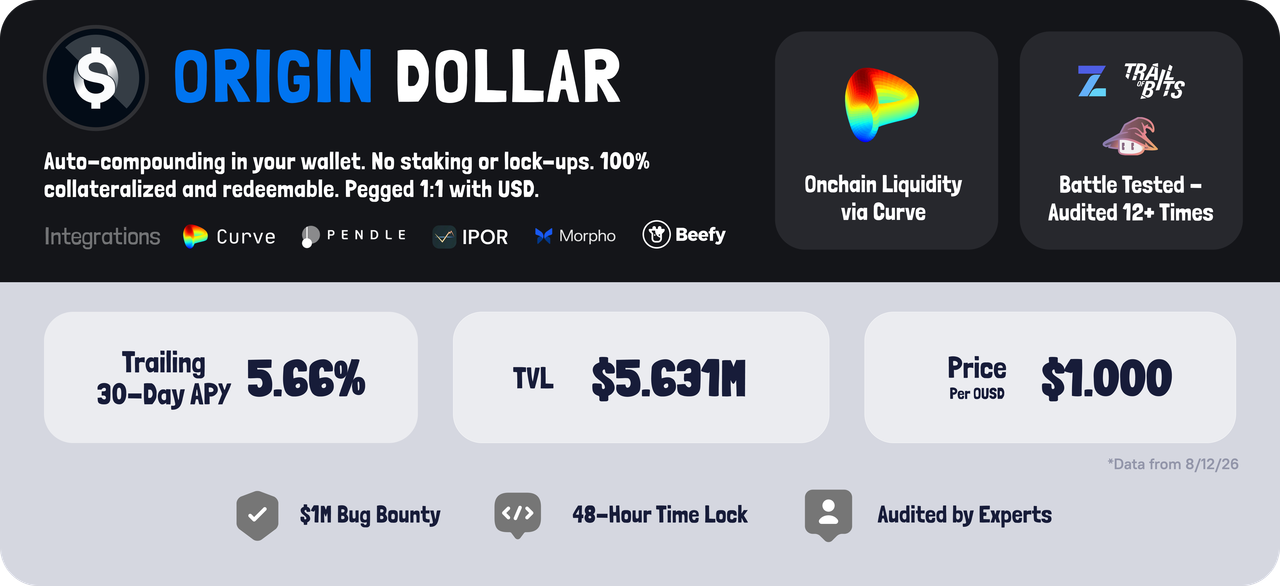
Launched in 2020 by Origin Protocol, OUSD is an ERC20 stablecoin that generates yield while sitting in your wallet or multi-sig. Backed 1:1 by USDC, holders can go in and out of OUSD as they please. Yield is paid out daily and automatically (sometimes multiple times per day) though a positive rebase in the form of additional OUSD, proportional to the amount of OUSD held. OUSD yield, currently ~5.5% APY, comes from a combination of:
- Deploying USDC collateral to a Curve AMO
- Lending USDC collateral to Morpho on ETH mainnet, Base, and Hyperliquid
- Reward tokens (MORPHO, CRV, and CVX) are automatically claimed and converted to stablecoin
- OUSD sitting in non-upgradable contracts does not rebase, instead the interest generated from those tokens is provided to those that can rebase
Current and historical OUSD yields can be seen via the OUSD analytics page at all times. Proof of Yield tracks every OUSD yield event as the yield is distributed.
There is no set emission schedule for OUSD - similar to stETH, OUSD is minted on demand when users deposit their stablecoin into the protocol, and burned on demand when users redeem OUSD for the collateral USDC. OUSD is completely non-custodial, there are no lock-ups, terms, or conditions. Any web3 wallet can support OUSD and its rebasing function, including hardware wallets and multi-sigs. There is no need to ever again give up the keys to a 3rd party platform, such as Celsius, Blockfi, or FTX, to earn yield on stablecoin.
A visual representation of OUSD’s design appears as follows:

Similar to wstETH, there is a corresponding tokenized vault version of OUSD, which is wOUSD. wOUSD is a ERC-4626 tokenized vault designed to accrue yield in price rather than in quantity. When you wrap OUSD, you get back a fixed number of wOUSD tokens. This number will not go up - you will have the same number of wOUSD tokens tomorrow as you have today. However, the number of OUSD tokens that you can unwrap to will go up over time, as wOUSD earns yield at the same rate as standard OUSD. The wOUSD to OUSD exchange rate can be read from the wOUSD contract (function number 16), or via the OUSD dapp.
Current exchange rate as of 8/12/26: 1 wOUSD = 1.30141137 OUSD
Risk Mitigation
There are three risks when using OUSD, and Origin is making sure to reduce each risk as much as possible:
Smart contract risk of the yield strategies - Origin is only using platforms for yield generation that have a proven track record, have been audited, have billions in TVL, maintain a bug bounty program, and provide over-collateralized loans. Over-collateralization in itself, combined with liquidations, provides a reasonable level of security for lenders.
Stablecoin risk - Origin has chosen USDC, one of the largest stablecoins to ever exist, to back OUSD, and it has stood the test of time and maintained its peg quite well through multiple bull and bear cycles. It has also demonstrated significant growth in circulating supply, so the Origin team is confident that USDC will maintain its peg and that OUSD will remain stable. OUSD also uses a Chainlink oracle for pricing data for USDC to ensure accurate pricing at all times. If USDC falls below its $1 peg, OIP-4 disables minting of additional OUSD tokens using the de-pegged asset.
Smart contract risk of OUSD - Origin is taking every step possible to be proactive and lessen the chance of losing funds. Security reviews of OUSD are prioritized over new feature development, with regular audits being done, and multiple engineers are required to review each code change with a detailed checklist. A 48-hour timelock goes into effect before protocol upgrades are launched, and deep dives into the exploits of other protocols are constantly being done to make sure the same exploits don’t exist on Origin contracts. Security is extremely important to the Origin team. 12+ audits have been done on the OUSD codebase since 2020, all of which can be seen on Audits - OUSD. Origin also holds a top three spot on the Immunefi leaderboard for average response time for bug bounty submissions, and maintains a $1m bug bounty.
Contracts being called
- USDC ‘approve’ (approves the usage of the USDC from the wallet)
- OUSD vault ‘mint’ (receives OUSD using USDC at a 1:1 rate)
- OUSD ‘approve’ (approves the usage of the OUSD from the wallet)
- wOUSD ‘deposit’ (wraps OUSD into wOUSD)